
Hampshire County VINE Coverage
West Virginia calls the service Victim Information Notification Everyday, or VINE. A state implementation announcement confirms that VINE receives information from all ten regional jails and all state correctional facilities. That coverage includes Potomac Highlands Regional Jail and Correctional Facility, where adults on Hampshire County matters are ordinarily held, and later WVDCR prison placements.
VINE serves two related purposes. A one-time VINELink lookup reports what the participating custodian supplies now. Registration asks the system to send notice after a later status change. Neither function is a historical Hampshire County release list. A released result can support that the named reporting facility no longer holds the person, but the facility record and the Hampshire court case remain the better sources for the exact departure time and legal reason.
Coverage follows the custodian, not the county label. Potomac Highlands also serves Grant, Hardy, Mineral, and Pendleton counties. Confirm the Hampshire connection through the charge, case, arresting agency, or court record. The same VINELink search may also find a state prisoner whose custody did not begin with a Hampshire matter.
Search a Hampshire Inmate on VINELink
Start at the official VINELink portal and choose West Virginia. Search one person at a time. Use the full legal name and a known offender or booking identifier when the interface offers that option. Name variations may be needed, but identity details should decide the match.
- Select West Virginia and open the offender or person search.
- Enter the committed name. Add an agency identifier when known because it is more reliable than a common name.
- Compare every possible match using the reporting agency, facility, status, identifier, and available identity details.
- Open the correct record and preserve the exact custody wording, last-update information, and source check time.
- If the record says released or not in custody, verify the event with Potomac Highlands, WVDCR records, and the related court file.
A missing VINELink result does not prove release. The name may differ, the event may not yet be supplied, the person may be in another system, or the query may not match. The Hampshire County released-inmate lookup sets out the broader route through Regional Jail OIS, court records, WVDCR corrections, and outside custodians when VINE alone does not resolve the status.
Note: Save the reporting facility and update time with the status so the result can be checked against later records.
Read Hampshire VINELink Release Fields
VINELink labels can change, and fields depend on data supplied by the participating agency. Preserve the portal’s wording. Do not turn a blank field into a claim. The following inventory reflects the Hampshire research and identifies how each result should be used.
| Observation | What it supports | What it does not prove |
|---|---|---|
| Reporting facility | Which jail or correctional site supplied the record | That the underlying case is from Hampshire County |
| Custody status | The status reported by that custodian | The complete status under every agency or case |
| Offender or booking identifier | A stable link to the correct person and follow-up request | The legal reason for release |
| Status or update date | When the reported information changed or was refreshed | The physical departure time unless expressly labeled that way |
| New facility | Likely custodial movement after the prior listing | Release to the community |
| Released or not in custody | Exit from the reporting custodian | No detainer, supervision, new arrest, or custody elsewhere |
Scheduled, projected, and actual dates are not interchangeable. A projected release date is a calculation that may change. A custody-status date may reflect a system event. The WVDCR facility release report or release-book entry is the stronger record for an actual Potomac Highlands departure, while the court order explains its authority.
Hampshire VINELink Portal View
The manifest’s successful capture comes from the official VINELink state search and shows the lawful state-selection, person-search, and notification workflow.
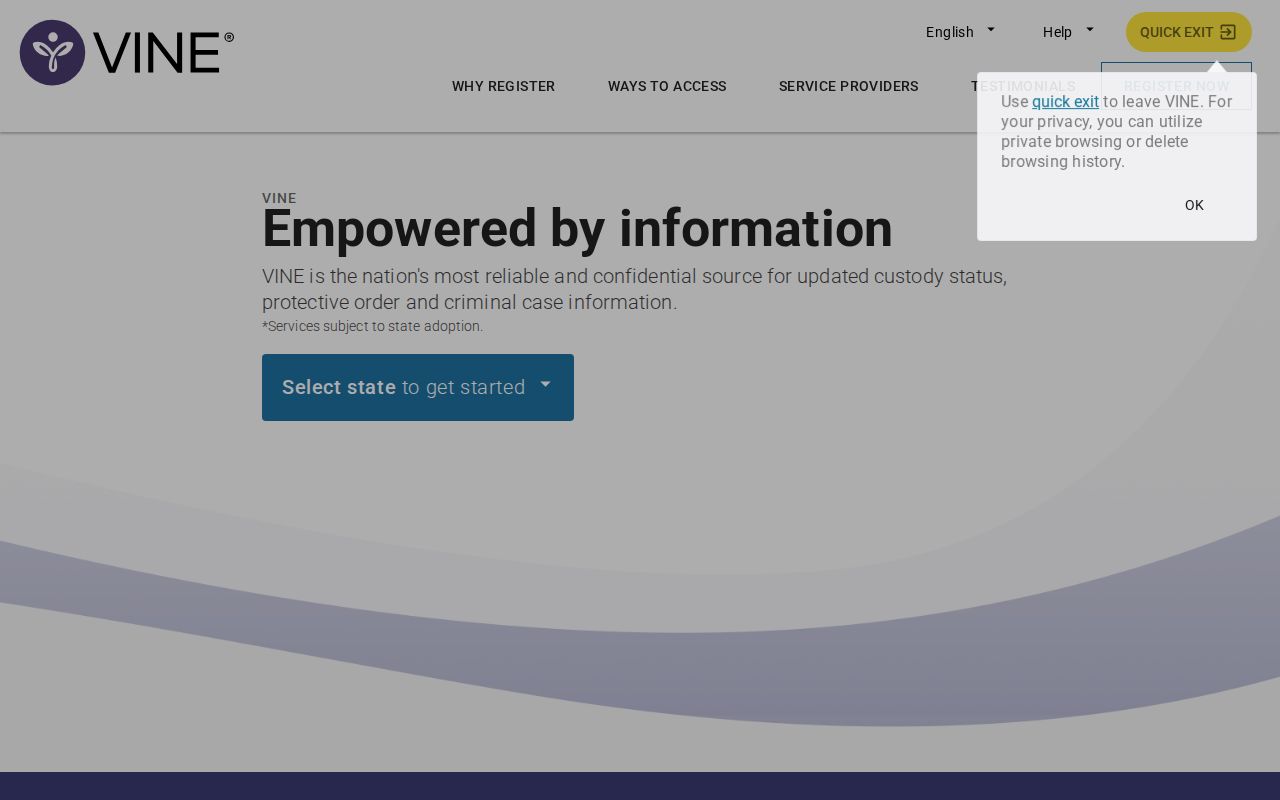
The screen is an access point, not a Hampshire release roster. Select West Virginia, match one person carefully, and use the returned custodian and status fields for the next verification step.
Set a Hampshire Release Alert
Open the correct person’s record before registering. West Virginia’s rollout identifies app, phone, email, and text channels, although the options offered can vary by record and system setup. Check the person and delivery destination before the final submission.
- Select “Notify Me of Status Changes” or the current equivalent on the matched record.
- Choose an offered delivery channel, then enter the phone number, email address, or app destination.
- For telephone notice, create the four-digit PIN when prompted. This PIN confirms receipt of a call; it is not the offender identifier.
- Add another destination if offered, then review the person, facility, and contact method on the confirmation screen.
- Submit the registration. When an automated call arrives, follow the prompt and enter the PIN to stop repeat calls.
Keep the PIN private. Do not place a real contact address, phone number, or PIN in a public image. An alert reports the agency event described by the message. Save it, then confirm whether the event was release, transfer, or another custody change.
Why Hampshire Transfer Alerts Lag
West Virginia’s regional-jail coverage makes VINE directly useful for Hampshire detainees, but the state describes one vital timing rule. A transfer notification is not sent while movement is underway. It follows arrival at the new facility. This is the local victim-notification layer highlighted by the Hampshire research.
The delay explains an otherwise confusing sequence. A person can disappear from the Potomac Highlands current roster, yield no clear destination for a time, and then generate a notice from another WVDCR site. That pattern supports transfer, not community release. Wait for the receiving status or call the responsible facility before describing the person as released.
VINE also has a formal written-notice layer. Under West Virginia Code §62-12-23d, a person seeking the statutory notices described by WVDCR must write separately to WVDCR and the West Virginia Parole Board. They are separate agencies. WVDCR states that its written request produces VINE registration, but it does not replace the separate Parole Board request.
Note: A temporary notification gap during transfer is not proof that the person has left all government custody.
Hampshire VINE and Written Notice
Self-service VINELink registration and formal statutory notice are related but distinct. The online option is tied to a person’s current record and offered status-change channels. The formal route described by WVDCR requires a written request. A person who seeks both WVDCR release notice and Parole Board hearing or release notice must contact both agencies because the Board is independent of WVDCR.
Use a full name, known OID, facility, case or conviction county, and a reliable private contact destination. Keep copies of both written requests. WVDCR says its written victim-notice request automatically registers the requester in VINE. That does not prove the Parole Board received a separate letter. Confirm delivery with each office and update the contact information when it changes.
The legal layers also cover different events. VINE reports custody changes supplied by participating facilities. The Parole Board addresses parole hearings and decisions. A Hampshire County court may control notice related to release pending proceedings, work release, home confinement, or probation for covered offenses under West Virginia Code §61-11A-8. Match the notice request to the agency that controls the event.
Hampshire VINELink Is Not a Registry
The West Virginia State Police Sex Offender Registry is a separate official system for people with a continuing duty to register under state law. It is not a general released-person search. A registry record does not prove that Potomac Highlands released the person, and absence from that registry says nothing about a person outside its legal scope.
Use the registry only when that statutory duty is relevant. Use VINELink for the participating custodian’s status and alerts. Use the facility record for actual departure. This separation prevents a specialized public registry from being treated as proof of a recent Hampshire County release. Suspected registry errors should go to the State Police registry unit, while VINELink status questions belong with the reporting facility or WVDCR.
Confirm Hampshire VINELink Results
VINELink does not cover federal Bureau of Prisons custody. A federal sentence requires the BOP Inmate Locator. A recent federal pretrial detainee may remain under the U.S. Marshals Service, and an immigration transfer belongs in the ICE locator and responsible federal channel. A Hampshire arrest alone does not place each later event in VINE.
For Potomac Highlands, call 304-496-1275 to ask whether the person remains physically held and where to direct a release-record request. WVDCR is the custodian for the facility’s operational record. Request the booking or commitment record and the entry showing actual departure date, time, reason, and receiving agency when recorded. Use the Hampshire court docket or order for bond, dismissal, probation, sentencing, or another judicial reason.
The WVDCR prison search serves a different check. It may show a person who moved from the regional jail into active state correctional custody or supervision. Search by OID when known, or use the required name criteria, then compare identity and location. A no-result is not a discharge record. It may reflect the active scope of the database, a name issue, or a later data change. Request a timesheet, discharge record, or other dated WVDCR record when the question concerns the end of a state sentence rather than exit from Potomac Highlands.
The telephone alternative is 1-866-WV4-VINE. WVDCR says help is available at all times for status checks and registration. Automated notice should not be the sole source for an urgent safety need. Call 911 when danger is immediate, and contact the responsible facility for direct custody confirmation.